
Traces
08.09.1796.

A bishop of Bačka, Jovan Jovanović, consecrated the church of Sombor dedicated to St. Jovan Preteča, the construction of which had been finished six years earlier, and there will be more than a decade when Pavel Đurković, an icon-painter from Baja, will finish his work. The church is "13 fathoms and 2 inches long, 5 wide and 6 fathoms high".
08.09.1856.
In Sombor dr PAVEL-PAJA DRAKULIĆ was born, the first person of Sombor at the turn of the 19th into 20th century. As the owner of a lawyer office he joined a political life of the town and of the Serbs from the region, through the National Party of count Albert Aponi, from which he was in 1892 from the opposition list in Sombor chosen in the Hungarian Parliament, which will happen again in 1901 and 1905, but with a programme of the Liberal Party. Two times he was chosen for the member of the National-church Parliament in Sr. Karlovci, but because of his eagerness for a proposal of a Law on obligatory citizen’s marriage, which was in many ways against the interests of national minorities, his mandate from 1902 was abolished by a decision of a radical majority in the Parliament. He was known as a hot-tempered and hasty man, who solved his disputes in duels. Living very luxuriously, he had many debts, and he committed a suicide by a gunshot in the night between 7 and 8 July 1907 in Budapest.
09.09.1781.
A parish from Bač, Ksaver Gažlević, consecrated the opening of THE CHAPEL OF SNOWY MARY constructed in a homestead settlement Čičovi, near Sombor, which had been raised by money of Josip Marković, a senator for life and, in the meantime, Chief Justice of the Free and Royal City of Sombor. A procession of many people came to the Chapel, led by Bona Mihalović, an administrator of the Franciscian and Capistranian fraternity in Sombor. The church benefactor organized a lunch for invited guests. Ever since then people gather there on that holiday.
09.09.1791.
A Chief Justice of Sombor JEFTIMIJE POPOVIĆ and all his close family: his wife Jelisaveta and his children Aron, Jovan, Đorđe, Nikola, Leposava, Sofija and Katarina, got a noble title, with which they had to turn their last name into a Hungarian variant, Paphazi. In the Bačka Parish nobility was announced in 1793.
10.09.1742.
Through mediation of Jozsef Lasoncy, THE CONTRACT ON COLONIZATION OF BEZDAN MOOR was signed. According to it, the first 60 Hungarian families from Veszprem, Tolna, Baranja and Somody parishes, as free peasants got in rent some state land and started to build their own habitats. The buildings were mostly built of thatch and mud, as well as the first church which burnt down in the fire in 1755, so in the following year the new one was built, now using harder material. By that the strengthening of the Hungarian national element in this part of Bačka started. In 1745 the settlers started paying a tax, and three years later, Bezdan already had the population of 1.492.
11.09.1697.
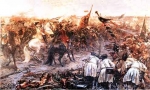
The Austrian army, under the command of Eugene of Savoy in THE BATTLE OF SENTA triumphed over the Turks, throwing them across the rivers Sava and Danube in the direction of the south. 500 hundred citizens of Sombor took part in the battle, led by captain Jajić. After the defeat, one unit of the Turks entered Sombor, but remained citizens in it, mostly women, old people and children, managed to force them out, so as a remembrance of it, ever since then till 1941, every night at 9 o’clock the bells of all the churches in Sombor sounded. That victory was captured in the painting which has the same name and which, being the largest oil on canvas in our country, decorates the Grand Hall of the Municipal Assembly building in Sombor.
11.09.1869.
From the direction of Subotica, the first train arrived to Sombor, joining it by that with a number of settlements which will be connected by so called “Lower Hungarian Railway”, starting from Subotica, across Sombor and the Danube, all to Rijeka, which was then called Fiuma. On that important occasion a banquet was given for 68 prominent citizens for which a caterer Edvard Bekei presented a bill on 408 forints to the Magistrate, asking from it to pay another 268 forints to him, since only 140 was raised from the guests. Very soon at the approach of the railway station, a mayor Petar Vukićević will initiate the raising of the first park in Sombor which still decorates this part of the town.
12.09.1687.
The Austrian regiments, led by general Weterani, without fight entered Sombor, which was, only several days earlier, left by its previous masters, the Turks. It was a day of celebration of the Christians for which they waited for the whole 146 years, since 1541 when Sombor had been conquered by Pertev Pasha, who had annexed it to the powerful Turkish Empire. Two years later it was for the first time under the name Sombor written in their records.
12.09.1892.
A meeting of the Town’s Assembly of Sombor was held, dedicated to the 90th birthday of Kosuth Lajos, a leader of the Hungarian Revolution in 1848/49. By a majority, 47 “for” and 12 “against”, it was decided that Kosuth will be declared a honorary citizen of Sombor and that the main street will carry his name. Interestingly enough, the suggestion was given by a Serb, dr Pera Cvetković, a headmaster of the Orthodox Church commune. Those who were against were, without exception, the government supporters, because in that time Sombor was the opposition town. Kosuth Lajos died in 1894 in Torino (Italy), where he lived in exile.

